
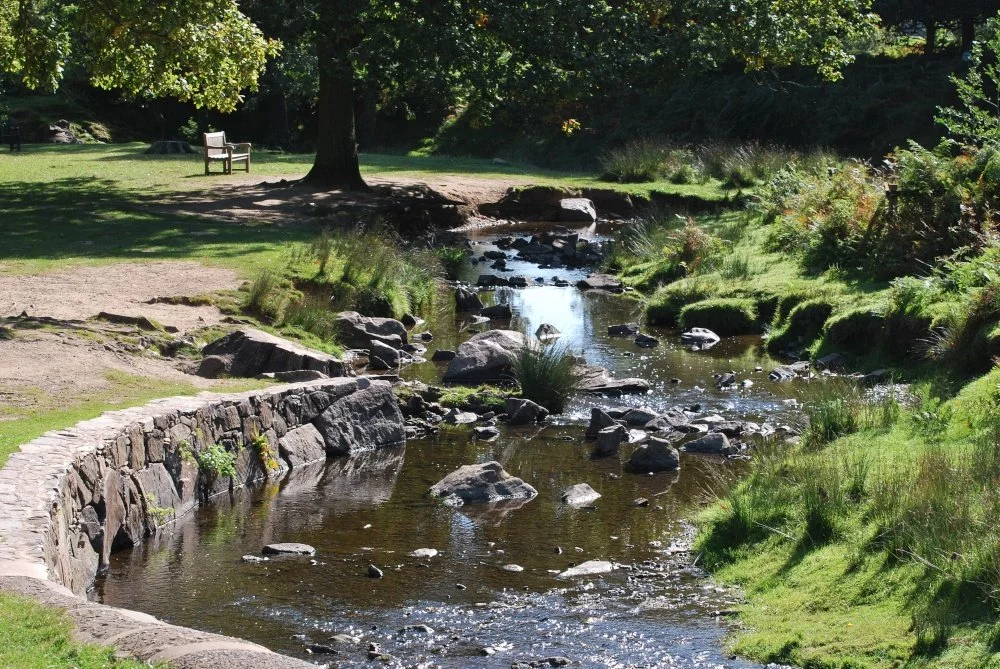
Bradgate Park is one of Leicestershire’s most important natural spaces, a nationally protected Site of Special Scientific Interest (SSSI).
On 5th- 6th July 2026, a major sewage pollution incident affected the River Lin, the small river that flows through the park and into the River Soar.
Clean River Action has now received official responses from both Severn Trent Water (STW) and the Environment Agency (EA).
This update summarises what we know so far, what is still missing, and the steps we are taking to ensure full transparency.
What Happened
A rising main (pressurised sewage pipe) beneath the Jade Tea Rooms failed.
Sewage escaped into a defective private drain and then into a defective highway drain, creating a direct pathway into the River Lin.
STW’s own timeline shows:
• Pollution continued for several hours
• Repairs failed more than once
• Tankers and aerators were deployed
• An overland pumping system was eventually installed
This was not a short or simple incident.
Water Quality and Fish Mortality
STW’s sampling shows extremely high ammonia levels:
• 23.2 mg/L at the outfall
• >15 mg/L in the unmixed discharge
• 7.02 mg/L downstream
Healthy rivers typically sit below 0.5 mg/L.
STW recorded 59 dead fish, including brown trout, bullhead, stoneloach, perch, gudgeon, and stickleback.
The EA confirm their officers took photographs of dead fish, but these have not yet been released.
Conflicting Classifications
The EA’s own incident record (NIRS) classifies Bradgate Park as:
Category 2- Significant impact in an SSSI
However, STW’s EIR response classifies the incident as:
Category 3- Minor impact, caused by third‑party drains
These two classifications cannot both be correct.
Clean River Action has asked the EA to confirm:
• whether they are aware STW are publicly calling this a Category 3 incident
• whether they accept or dispute STW’s classification
• whether they intend to challenge STW’s public narrative
Incident category affects enforcement, so this matters.
Missing Information from the Environment Agency
The EA’s response is noticeably limited compared to STW’s:
EA did not take laboratory samples
Despite:
• confirmed fish deaths
• extremely high ammonia levels
• pollution in an SSSI
• ongoing discharge at the time of attendance
EA sampled only upstream “clean” water.
EA’s NIRS record is almost empty
The official incident record contains:
• no pollutant description
• no cause description
• no fish kill entry
• no environmental impact fields
• no investigation notes
• no officer observations
This is highly unusual for a Category 2 SSSI incident.
EA’s ecological assessment is incomplete
The EA confirm an ecological survey was carried out, but the report is still “being processed” and has not been released.
EA have not provided photographs or raw field notes
These are environmental information and should be disclosable under EIR.
What Clean River Action Has Done
We have submitted a formal follow‑up request to the EA asking for:
• full incident recording system entries (NIRS & associated logs)
• Duty Officer logs
• ICS call notes
• internal communications
• raw field sheets
• photographs of dead fish
• draft ecological assessment
• clarification on the Category 2 vs Category 3 contradiction
• explanation for the lack of laboratory sampling
• confirmation of SSSI considerations
We have also asked the EA to explain why the Bradgate Park record is so limited when other incidents (including Knighton Park) have been documented in far greater detail.
Next Steps
We will:
• publish the EA’s follow‑up response when received
• continue to analyse the evidence provided by STW
• escalate to Natural England and the Office for Environmental Protection if necessary
• keep the public updated as the investigation progresses
Clean River Action will continue to push for transparency, accountability, and the protection of our rivers.